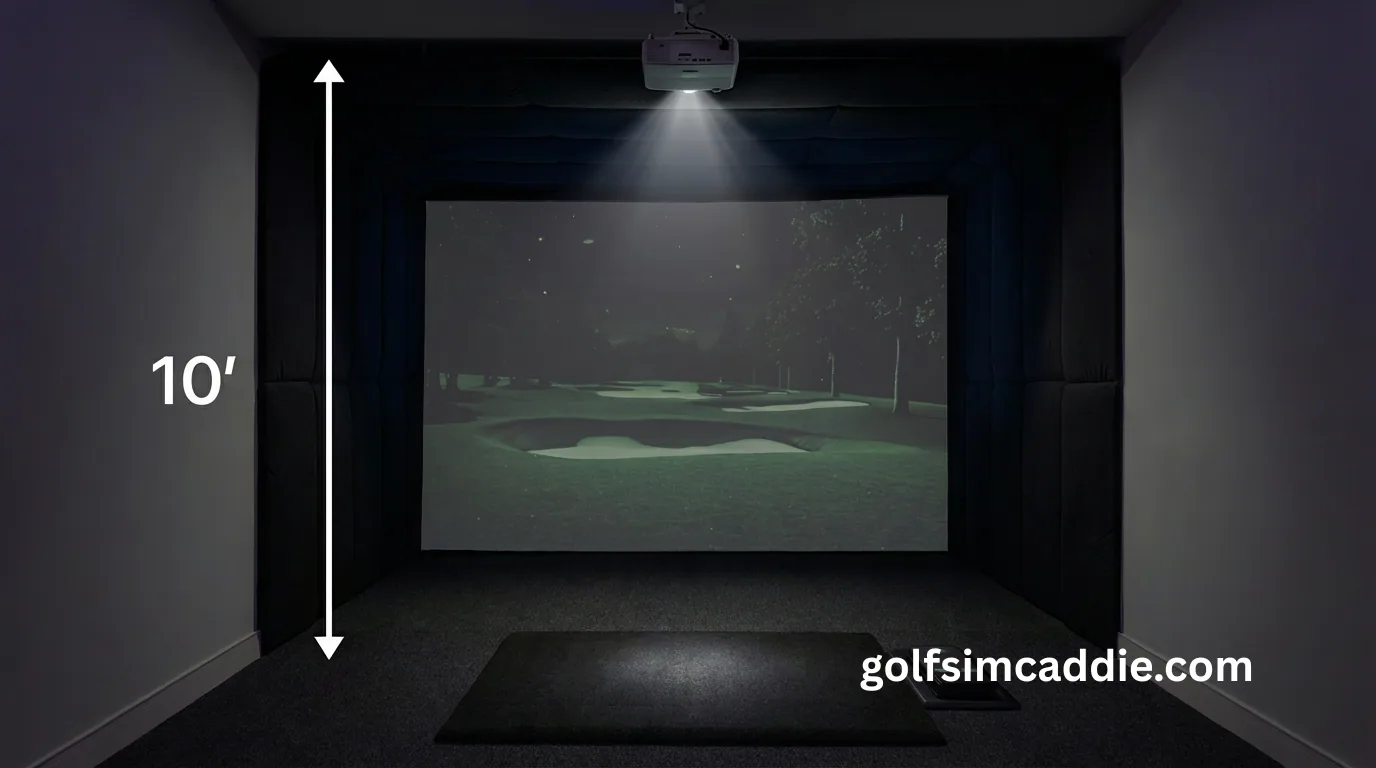
Search for golf simulator ceiling requirements and you'll find the same number repeated everywhere: 10 feet. It's become conventional wisdom that below that height, you can't swing a club safely. Above it, you're fine.
That rule is too simple, however. Plenty of golfers successfully run simulators in spaces with 8.5 to 9.5 foot ceilings. Others with 10-foot ceilings still hit the ceiling on certain shots. The real answer depends on factors that generic advice ignores.
Where Does The 10-Foot Number Come From?
The 10-foot recommendation exists because it provides a safe margin for most golfers swinging the majority of their clubs without needing careful measurement. It's a safe generalization that if you have 10 feet, you probably won't have problems.
But that safety margin includes a lot of assumptions:
- The golfer is average height
- The golfer takes a full, vertical backswing with driver
- No modifications to swing mechanics are acceptable
- The hitting mat adds no additional height
Change any of those assumptions and the requirement changes with them.
What Actually Determines Your Clearance Needs
Golfer Height and Arm Length
Taller golfers need more ceiling clearance. A 6'4" golfer with a full backswing will reach higher than a 5'8" golfer with the same swing mechanics. The difference can be 6-8 inches which is enough to move the requirement from 9 feet to nearly 10 feet.
If you're on the taller side, measure your actual swing apex rather than relying on generic recommendations.
Swing Type and Club Position
Not everyone swings the same way. A flat swing plane keeps the club lower throughout the backswing. A steep, upright swing brings the club closer to vertical at the top.
The club that reaches highest varies by golfer. For most people, it's the driver because it's the longest club with the widest swing arc. But some golfers reach their highest point with long irons because of how they set the club at the top.
The Club You're Swinging
Driver requires the most ceiling clearance. Wedges require the least. Many golfers who can't swing driver in their space can still hit every other club comfortably.
If your ceiling is marginal, you can practice full-speed wedge through 7-iron shots and accept that driver practice requires throttling back. That's not ideal, but it's workable.
Hitting Mat Height
Hitting mats add 1-3 inches of height depending on design. A thick mat with turf on top of foam brings the ball and your swing plane higher, relative to the ceiling.
If ceiling clearance is tight, a thinner mat might be able to buy you the margin you need.
How to Measure Your Actual Requirement
Generic rules don't replace actual measurement. Here's how to figure out what you specifically need:
Step 1: Find Your Swing Apex
Stand in your hitting area with your longest club. Take your normal backswing in slow motion and hold at the top. Have someone mark where the clubhead reaches its highest point relative to the ceiling.
Do this multiple times. Swing mechanics vary slightly from swing to swing, and you want to capture your highest position, not your average.
Step 2: Add Safety Margin
Take your measured apex height and add 6-12 inches. This accounts for:
- Natural variation in your swing
- Slight mishits where the club goes higher than intended
- The difference between a slow-motion swing and full-speed execution
If your clubhead reaches 96 inches and you add 8 inches of margin, you need 104 inches (8'8") of usable clearance from mat to ceiling.
Step 3: Measure Actual Clearance
Ceiling height isn't always what you think. Measure from the floor where your mat sits to the lowest point of the ceiling in the hitting area. Account for:
- Ceiling fixtures (lights, fans, bulkheads)
- Exposed beams or ductwork
- HVAC vents or sprinkler heads
- Projector mounts
The relevant number is effective clearance which is the lowest point in the swing zone, not the general ceiling height. Try to account for everything in the room.
Making Lower Ceilings Work
If your ceiling is potentially too low, you have options:
Modify Your Swing (not ideal)
Many golfers successfully train themselves to flatten their backswing in the simulator while maintaining a fuller swing outdoors. It's not a perfect solution, but muscles adapt, and the data from your launch monitor still works.
Limit Clubs
Practicing short irons, wedges, and putting is valuable even if you can't swing driver. Plenty of stroke improvement comes from 150 yards and in.
Lower Your Stance
Some golfers widen their stance or flex their knees slightly more in their simulator setup, dropping their overall height by an inch or two. This can provide just enough margin.
Upgrade Your Space Later
Starting in a tighter space gets you playing now. Future upgrades in a different room, basement modifications, or an outbuilding can give you more ceiling later. Don't let imperfect conditions stop you completely.
Our minimum room size guide covers the complete picture of space requirements beyond just ceiling height.
When to Walk Away
Some spaces simply don't work. If your measured requirement exceeds your ceiling height by more than a few inches even after considering modifications, you'll frustrate yourself trying to make it work.
Signs a space is too short:
- You hit the ceiling on slow-motion practice swings
- Even short irons feel constrained
- You have to consciously think about the ceiling during every swing
A simulator that makes you tense doesn't improve your game. Better to find a different space or wait until you can access one that fits.
Validating Before You Buy
Before spending money on equipment, validate your space:
- Measure your swing apex with a helper
- Measure effective ceiling clearance at the hitting position
- Compare the numbers with appropriate margin
- Decide which clubs you can realistically use
The Build Wizard can help you evaluate your overall room dimensions, including ceiling constraints.
The Bottom Line
The 10-foot ceiling rule is a general recommendation, not a law. Shorter golfers with flat swings can work in 8.5 feet. Taller golfers with upright swings might need every inch of 10 feet.
Measure your own swing. Measure your own ceiling. Add margin. Then decide what's realistic based on actual data, not rules of thumb designed for someone else.
Your simulator should make golf more accessible, not more stressful. If your space works, use it. If it doesn't, find one that does. The measurement takes ten minutes and saves months of frustration.