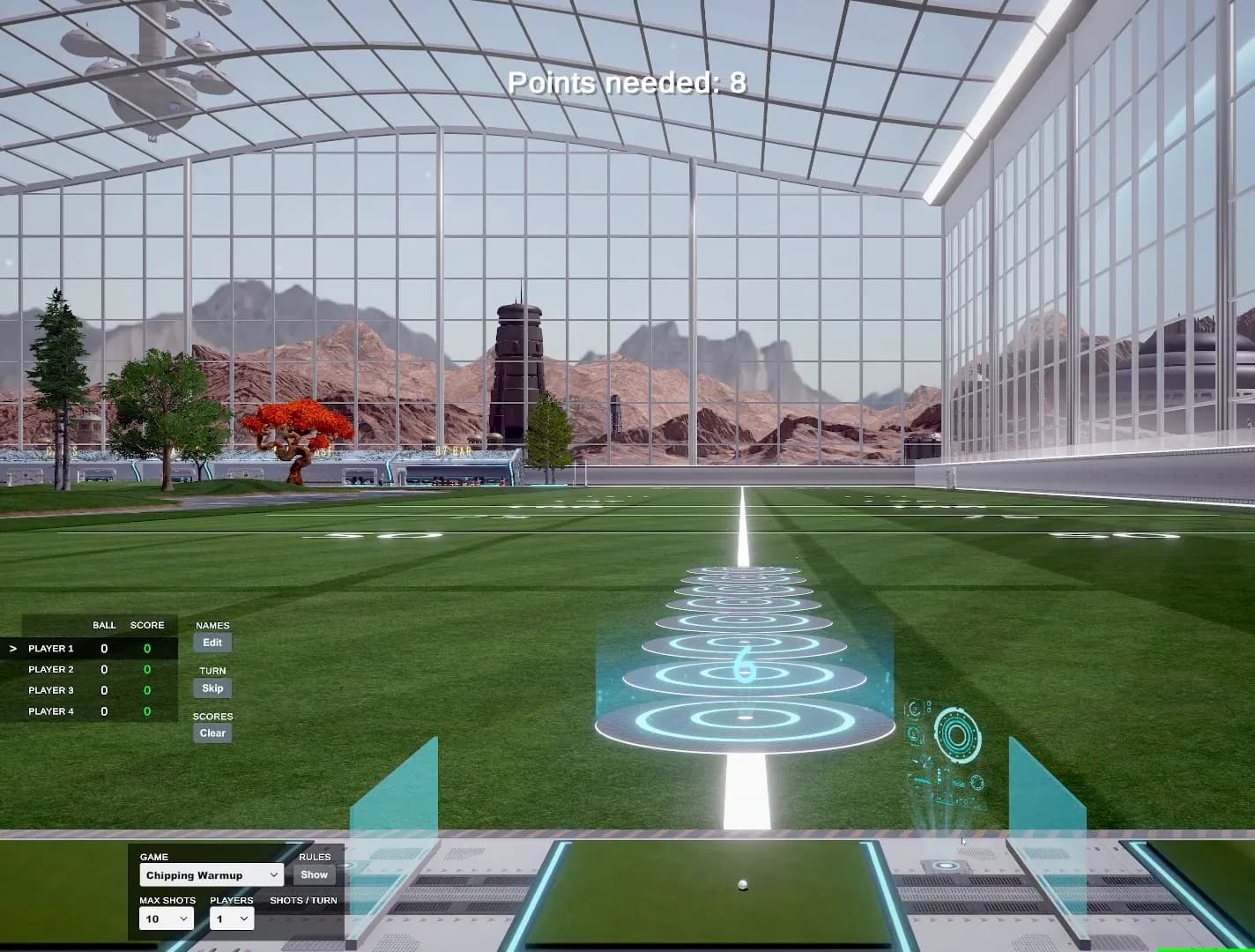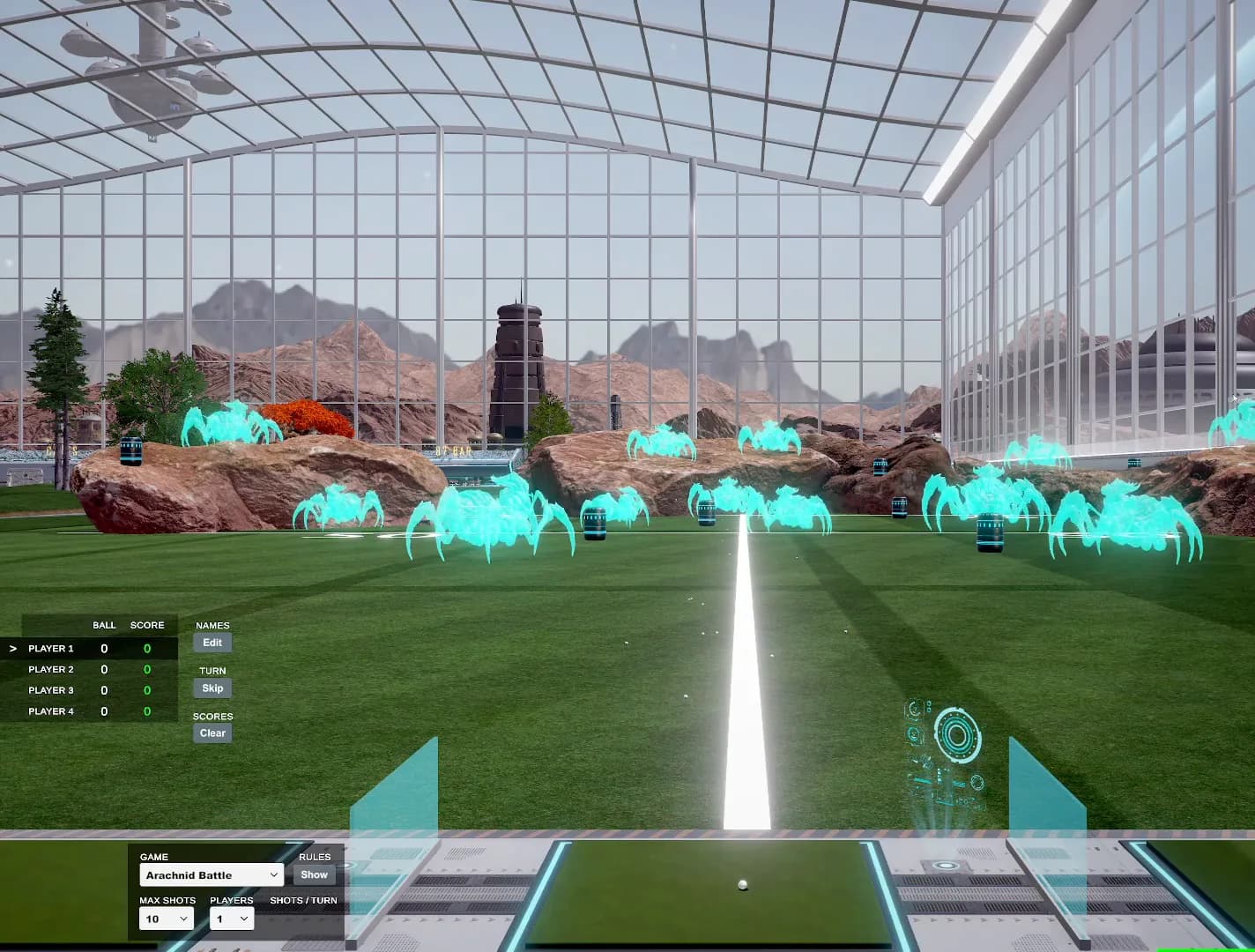
Outpost 87 is a golf course inside a biodome on a colonised planet. You hit under a glass roof with drones hanging from the frame, red rock and mountains outside the glass, and holographic chevrons for tee markers.
Its range has seven games on it, and they split neatly into two halves. Three are theme pieces you will want to show people. Four are among the most carefully specified practice drills anywhere in GSPro, with scoring bands measured in single yards.
The one people come for is the spiders. The one worth keeping the course installed for is a chipping ladder.
Built by rdeyer, who also built the Central Park range and the Riverwalk Skills Challenge.
Getting there
Load Outpost 87 through Local Match. On the Round Settings screen, the bottom bar has a HEAD TO THE RANGE! button next to the one that starts the round. Click that instead.
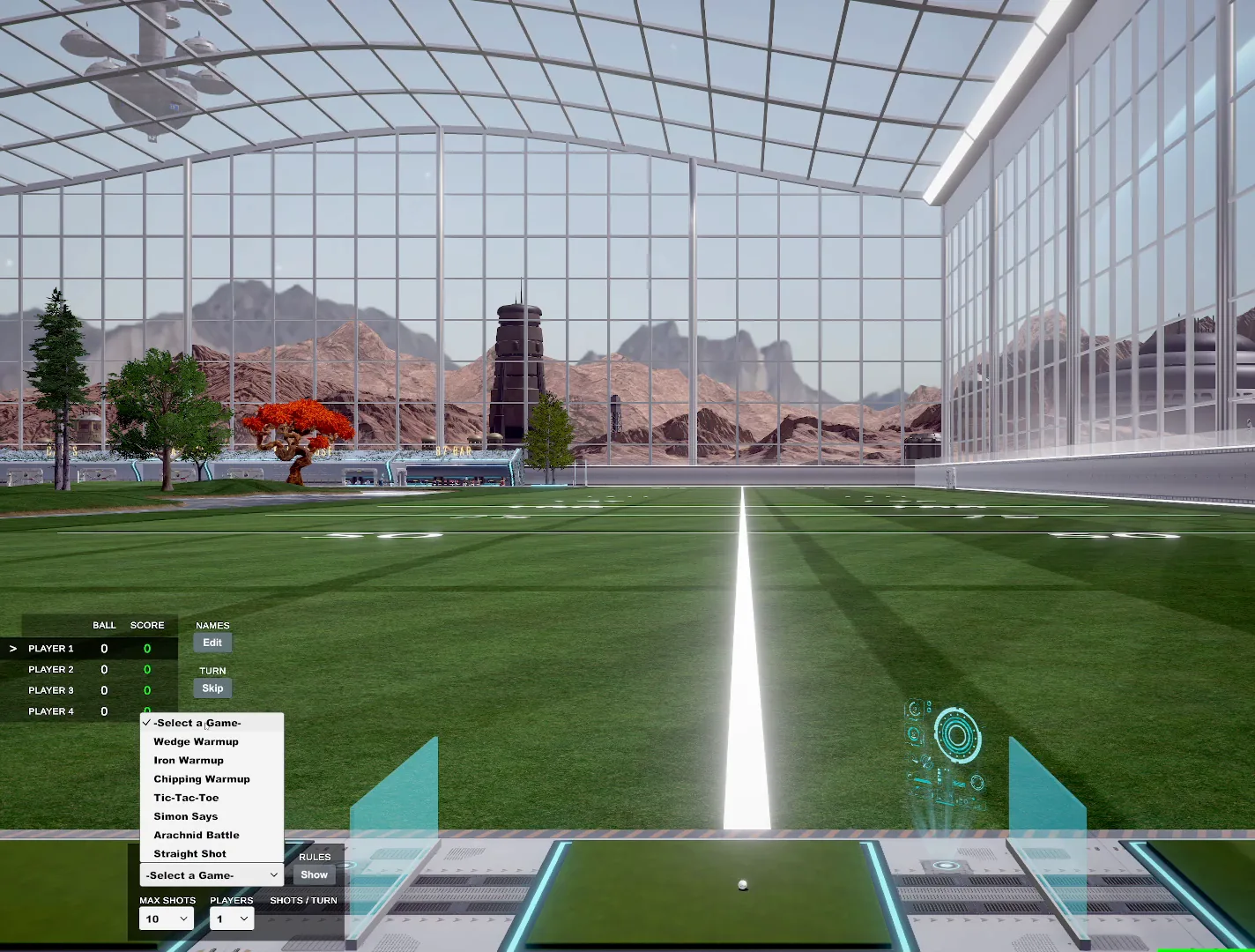
The game selector is the GAME dropdown in the bottom left, with RULES, MAX SHOTS (10 by default), PLAYERS (up to 4), and SHOTS / TURN beside it.
The dropdown holds the seven games plus a -Select a Game- option at the top. That first entry is not a placeholder: leaving it selected gives you a plain unscored range, which is a genuinely nice thing to have on a course this good-looking when you just want to hit balls.
Full detail on both menu routes is in how to find GSPro's hidden range games.
The three you will show people
Arachnid Battle
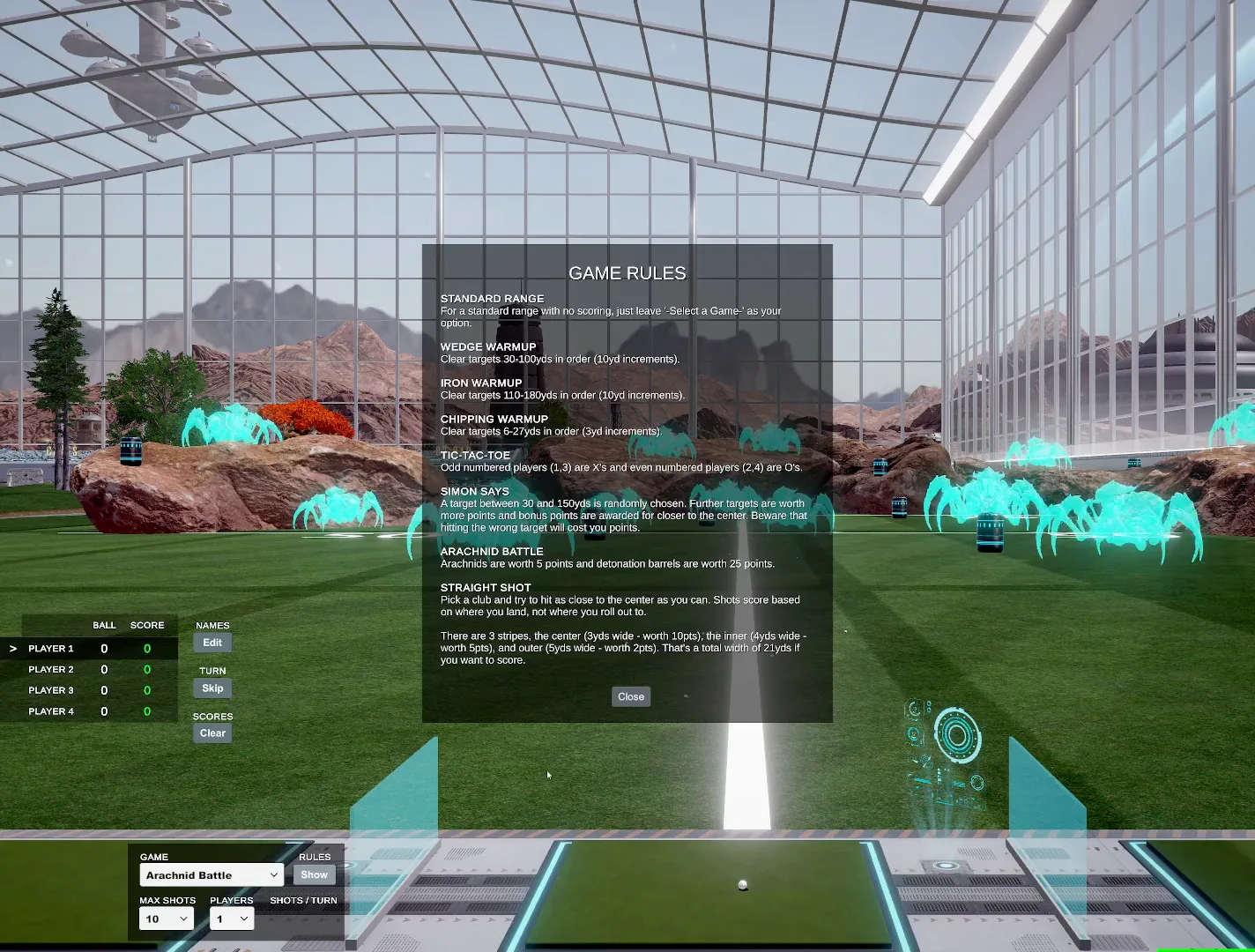
Glowing alien spiders spread across the range with detonation barrels sitting between them. Arachnids are worth 5 points. Detonation barrels are worth 25.
The 5-versus-25 split is the whole game and it is better designed than it first appears. The spiders are large, close, and easy. The barrels are small and worth five of them. So every ball is a decision about whether to take the safe 5 or go at something you will probably miss, which is a more interesting question than any pure target game asks.
Tic-Tac-Toe
Odd-numbered players (1 and 3) are X, even-numbered players (2 and 4) are O.
The same game as the Central Park version in a different setting. Still the best two-player format on any of these courses, still finishes in about five minutes with a winner. If you have the choice, play it on Central Park, because that course is free and this one is not.
Simon Says
A target between 30 and 150 yards is chosen at random. Further targets pay more, hitting closer to the centre pays a bonus, and hitting the wrong target costs you points.
The randomisation is the point. You never get to settle into a club, and the penalty for hitting the wrong target means you cannot bail out toward something easier when the one you were given looks awkward. That is a much closer simulation of golf than a range session spent hitting thirty seven-irons.
The four that will actually make you better
This is where the course earns its place, and it is the half nobody talks about. All four are "clear the targets in order" ladders, and the numbers are unusually precise.
Chipping Warmup
Clear targets from 6 to 27 yards in order, in 3-yard increments. Eight rungs: 6, 9, 12, 15, 18, 21, 24, 27. The screen prints "Points needed: 8" so you know exactly what finishing looks like.
Two numbers matter here. The 6 is where it starts, and the 3 is how fine the steps are.
GSPro's own built-in short-game ladder, over on the standard practice range, begins at 25 yards. So this one finishes roughly where the software's own short-game practice starts. The entire band below 25 yards, which is where most amateurs quietly leak strokes, is covered by this game and nothing else in GSPro.
Three-yard steps are the other half. Most golfers can feel the difference between a 40 and a 60 yard shot. Very few can reliably separate 12 from 15, and that is exactly the distance where a bad guess turns a straightforward up-and-down into a bogey.
It is dull to watch and it is the most useful thing on this list. Longer version here: the best GSPro warm-up nobody uses.
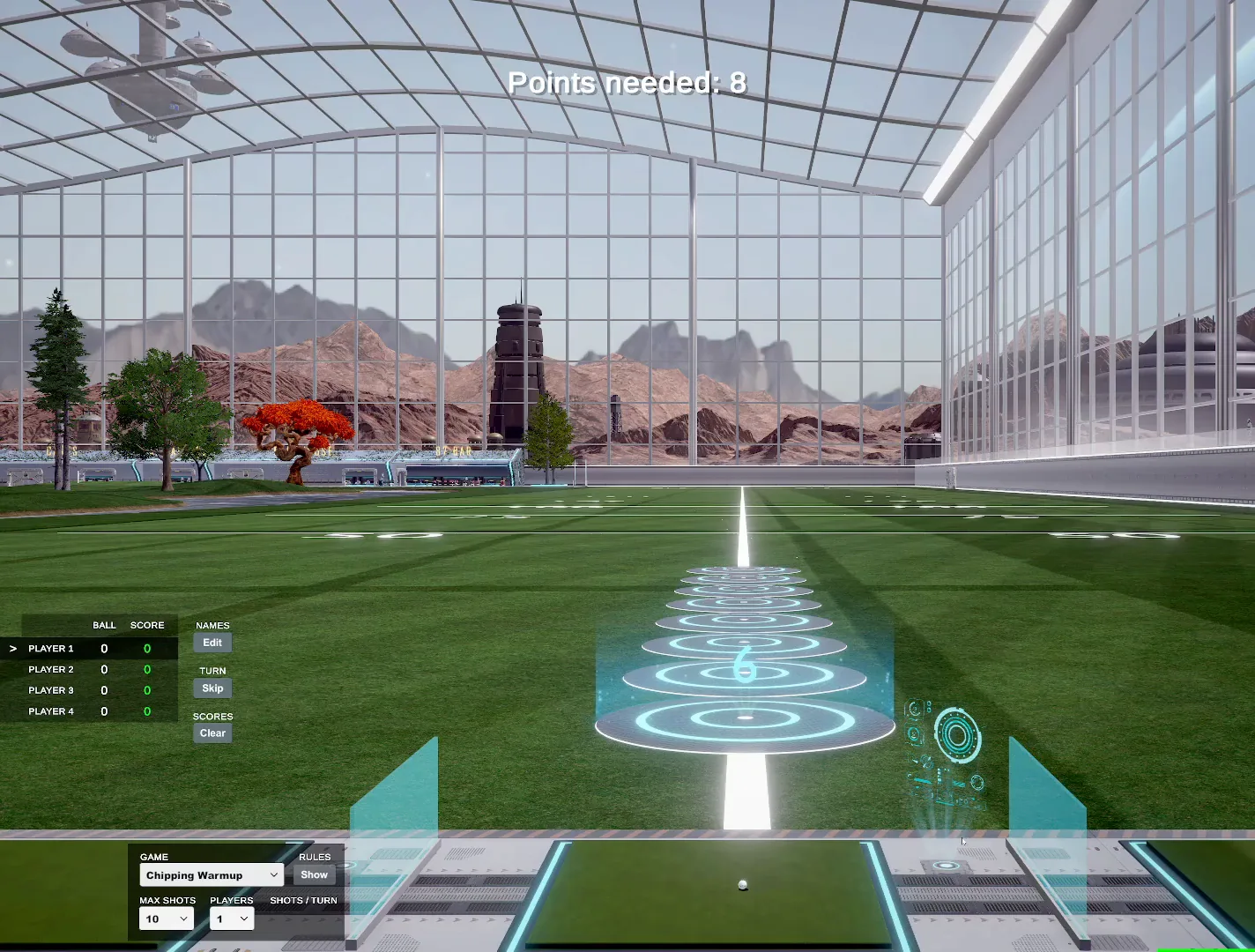
Wedge Warmup
Clear targets from 30 to 100 yards in order, in 10-yard increments. Eight rungs again.
Structured wedge work with a target instead of a number on a screen. Thirty to a hundred in tens is precisely the band where most people have a gap they have never measured, and having to clear them in order means you cannot skip the one you are bad at.
Iron Warmup
Clear targets from 110 to 180 yards in order, in 10-yard increments.
The long half of the same idea. Between this and Wedge Warmup you have a scored, in-order ladder from 30 to 180 yards, which is most of a bag.
Straight Shot
Pick a club and hit as close to the centreline as you can. Three stripes, and the widths are specific: centre 3 yards wide for 10 points, inner 4 yards for 5, outer 5 yards for 2. Anything wider than 21 yards total scores nothing. It counts where you land, not where you roll out to.
Not exciting, genuinely useful. Most "hit it straight" modes give you a vague corridor and a feeling. This gives you a 3-yard target with a number attached, and landing-not-rolling removes the luck of a good bounce.
A 20-minute warm-up on this course
Four of the seven chain into a better warm-up than most people get at a real range. Shortest to longest, finishing on the club you actually need warm:
- Chipping Warmup - the eight rungs from 6 to 27 yards. About 5 minutes.
- Wedge Warmup - 30 to 100 in tens. This is where you find the gap you cannot cover. About 5 minutes.
- Simon Says - randomised 30 to 150, so no two shots in a row use the same club. About 5 minutes.
- Straight Shot - driver, into a 3-yard centre band. About 5 minutes.
Twenty minutes, most of the bag, a target and a score on every single shot.
The honest limitation
Two things worth saying plainly.
Simulator short-game practice has a ceiling. Your mat is not a fairway lie, and no launch monitor reads a 6-yard chip as confidently as it reads a driver. What a ladder like this trains well is carry-distance control and club selection. What it cannot train is the contact you get from real turf. Treat the number as the lesson and the feel as approximate.
The second thing: all of this is buried inside a themed sci-fi course with alien spiders on it, which makes it very easy to write off as a gimmick and never open. That is precisely why the best short-game drill in GSPro is one almost nobody uses.
The mat matters more here than anywhere else
The limitation above is really a hardware point. A chipping ladder puts a few hundred short shots a week into the same patch of mat, which is the use case a cheap mat handles worst, both in how it reads and in what it does to your wrists and elbows. The hitting mats guide covers what to look for before you commit to that much repetition.
If the room is not built yet, the build planner sizes the rest of the setup around how you intend to practise, and the room-fit check tells you what fits the space you have.
Related
- The Best GSPro Warm-Up Nobody Uses - the chipping ladder on its own
- Every Hidden Mini-Game in GSPro, Ranked - all 24, with scoring
- How to Find GSPro's Hidden Range Games
- Central Park: All 10 Games, Free in Base GSPro