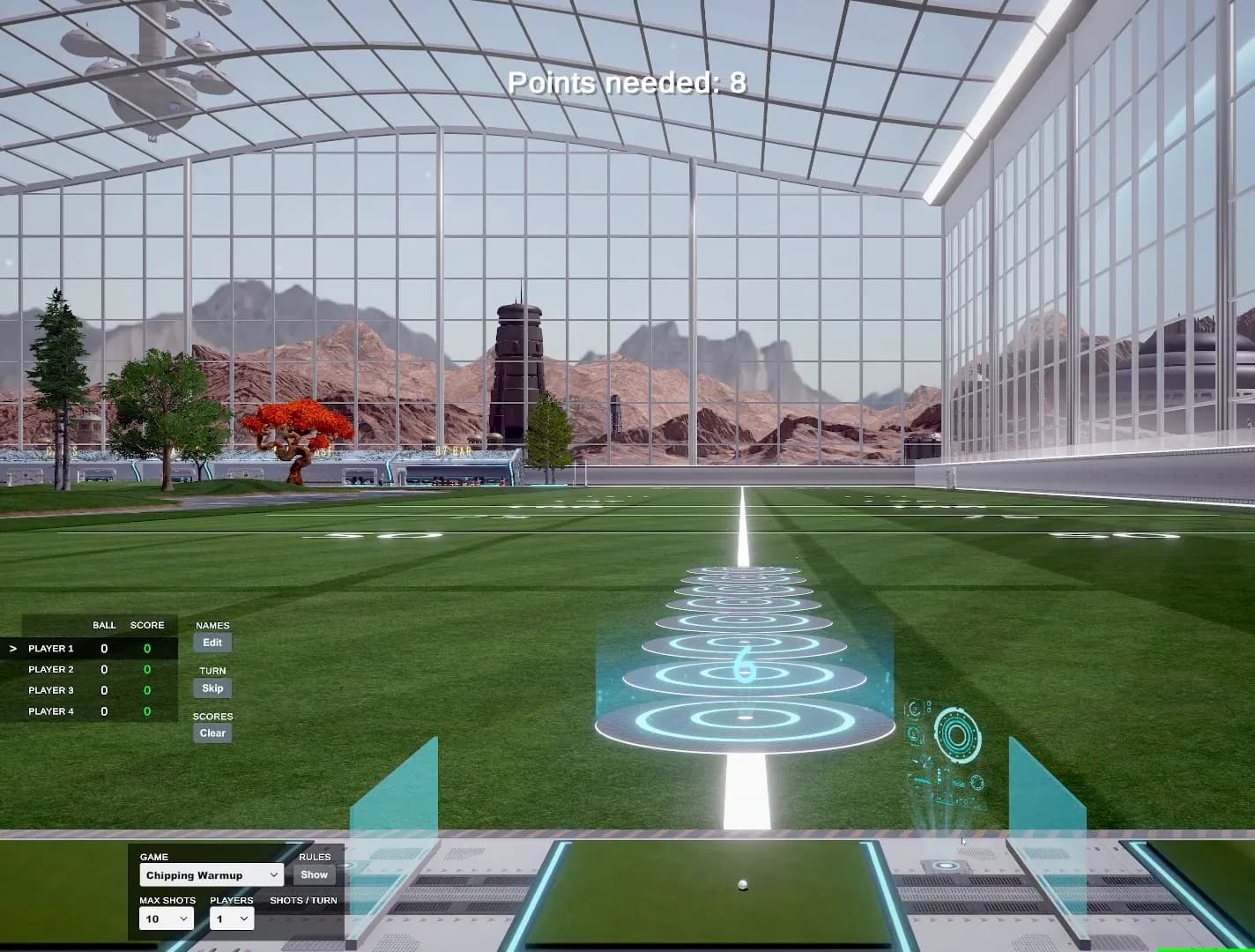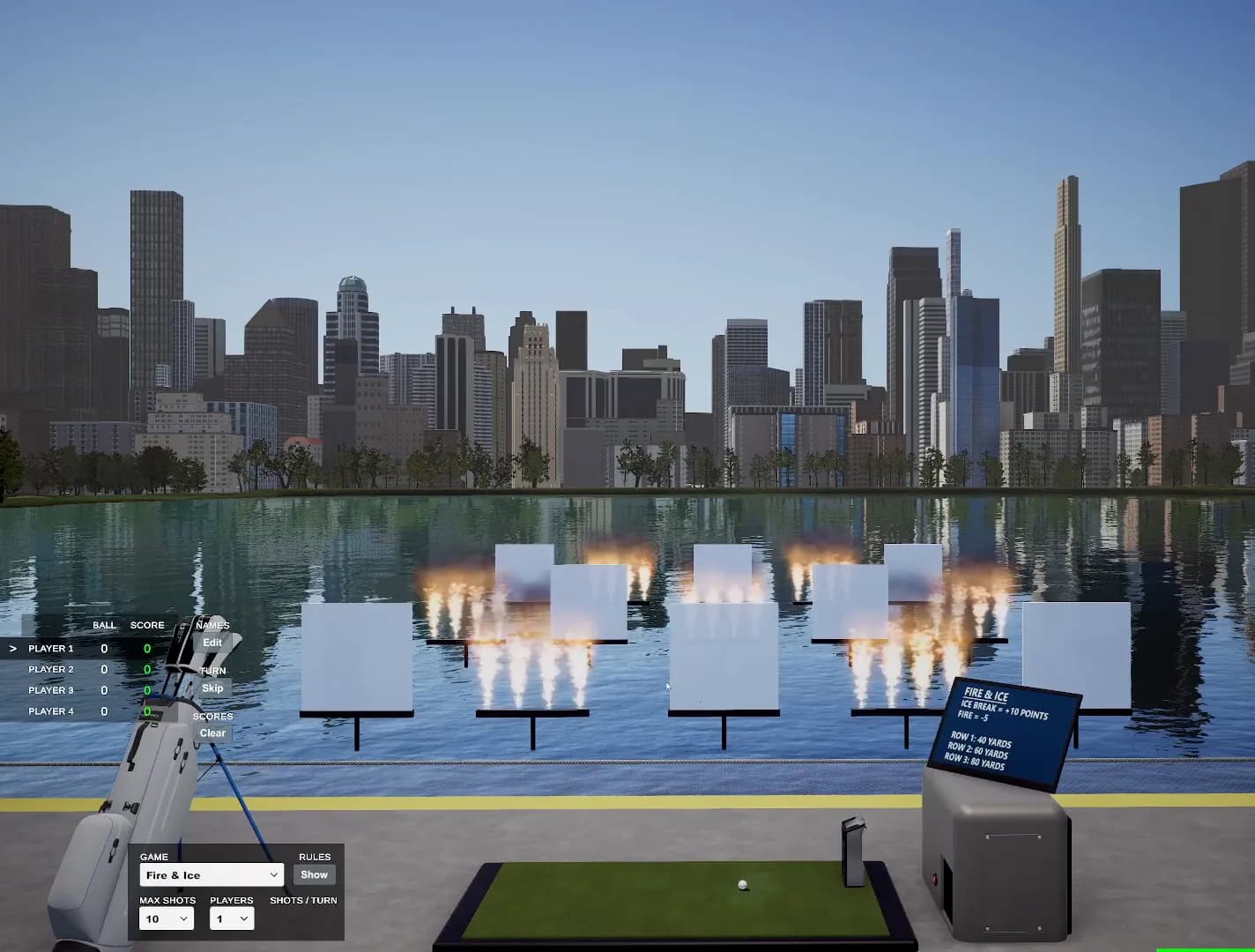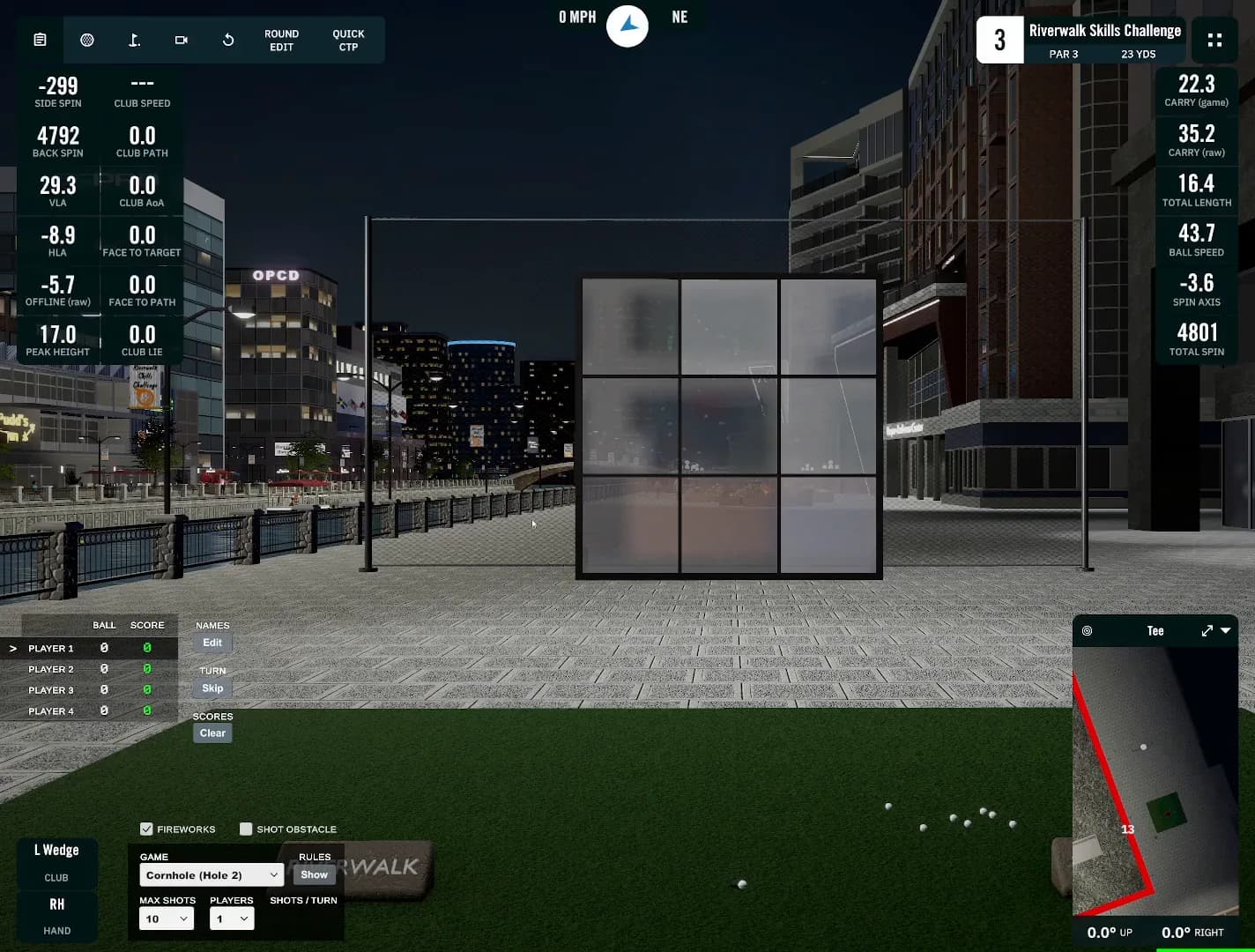
Riverwalk Skills Challenge is the original GSPro skills course, and it is the one people most often mention when the subject of hidden mini-games comes up. It is also the one they fail to find, for a specific and fixable reason.
Two of its seven games are barely covered anywhere. They are not in the course reviews or the video walkthroughs, which is easy enough to explain: they sit on holes most people never switch to.
Here are all seven, with the scoring from the in-game rules panel.
It will not load from Local Match
Load Riverwalk the way you load every other course and you will not get the games.
Riverwalk opens through Practice, then On Course Practice.
There is a logic to it. On Riverwalk the games are not sitting on a driving range, they are the holes. The dropdown entries say so: Cornhole is Hole 2, Break Glass is Hole 3, Elimination is Hole 4. A game per hole is a course, not a range, which is why it needs the on-course route.
Once you are in, the GAME dropdown is in the bottom left, alongside RULES, MAX SHOTS (10 by default), PLAYERS (up to 4), and SHOTS / TURN. Two checkboxes sit above it: FIREWORKS, which is on by default, and SHOT OBSTACLE.
The full access path for every course with hidden games is in how to find GSPro's hidden range games.
Choosing a game does not move you to it
This is the second thing that trips people, and it is worth knowing before you decide a game is broken.
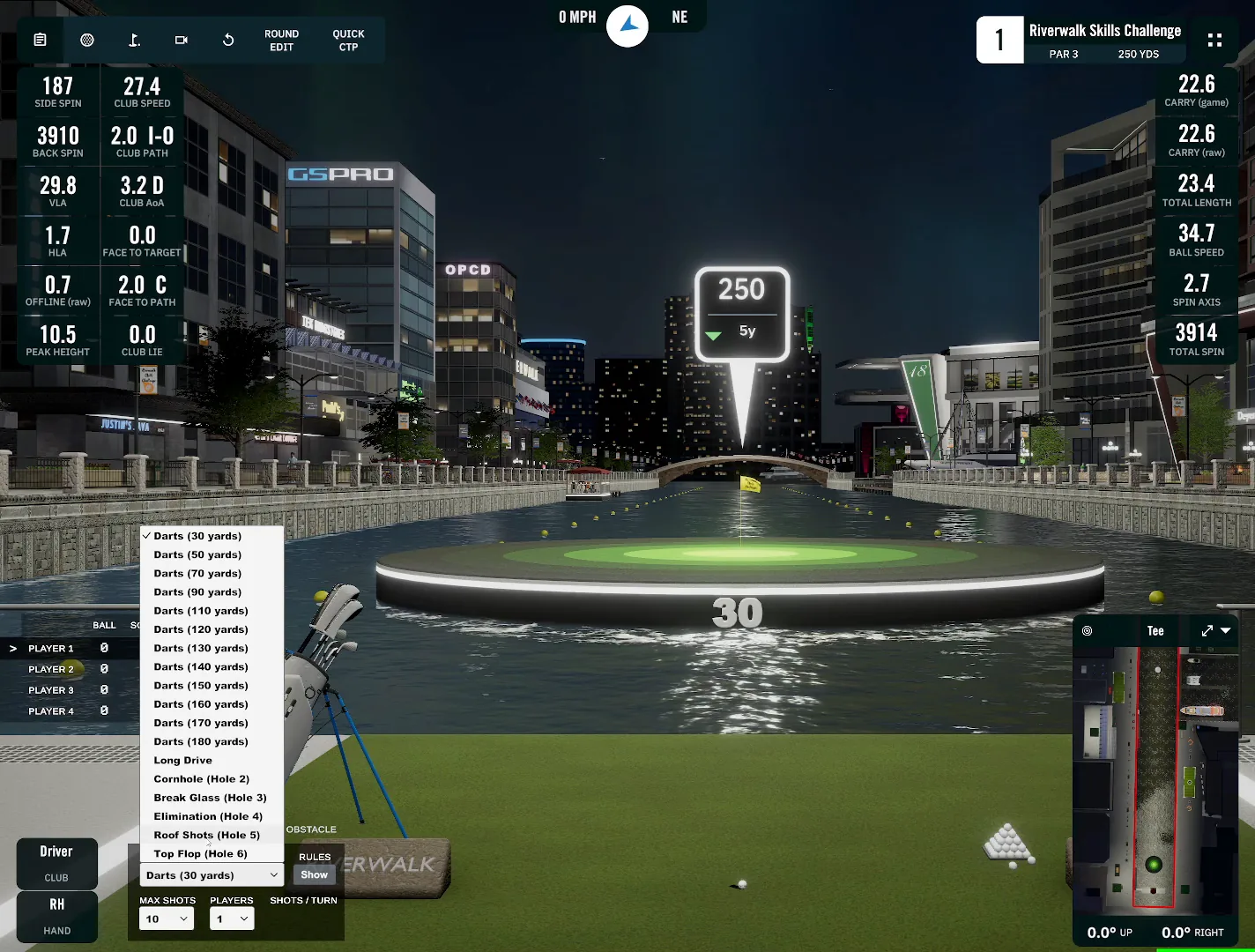
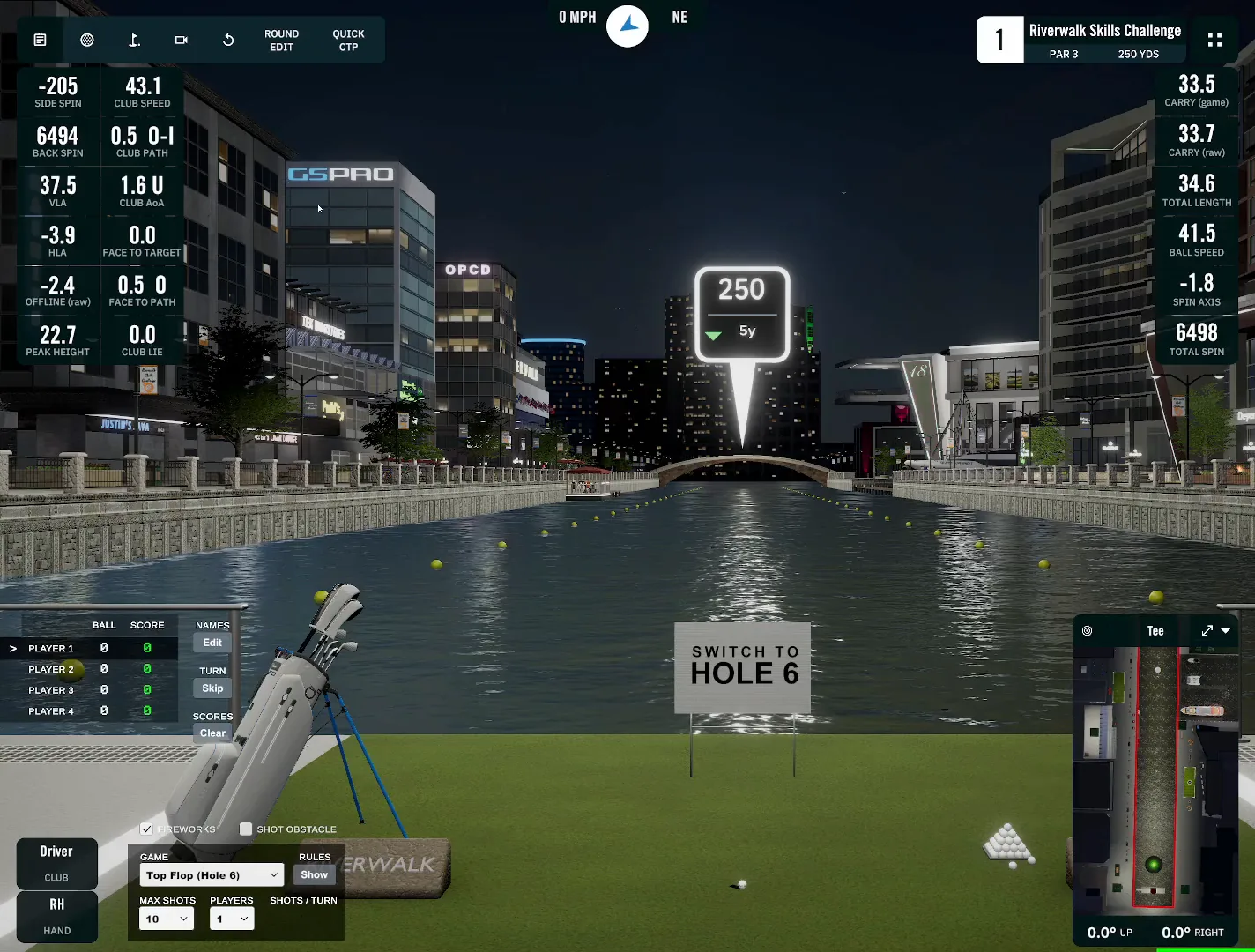
Selecting a game in the dropdown does not walk you to the hole it lives on. You stay where you are. GSPro tells you about it with a sign that appears on the tee reading SWITCH TO HOLE 6, or whichever hole the game you picked belongs to. Change hole from the hole selector and the game is there waiting.
If you pick Top Flop and find yourself staring at 250 yards of open river, that is what has happened. You are still on Hole 1.
The seven games
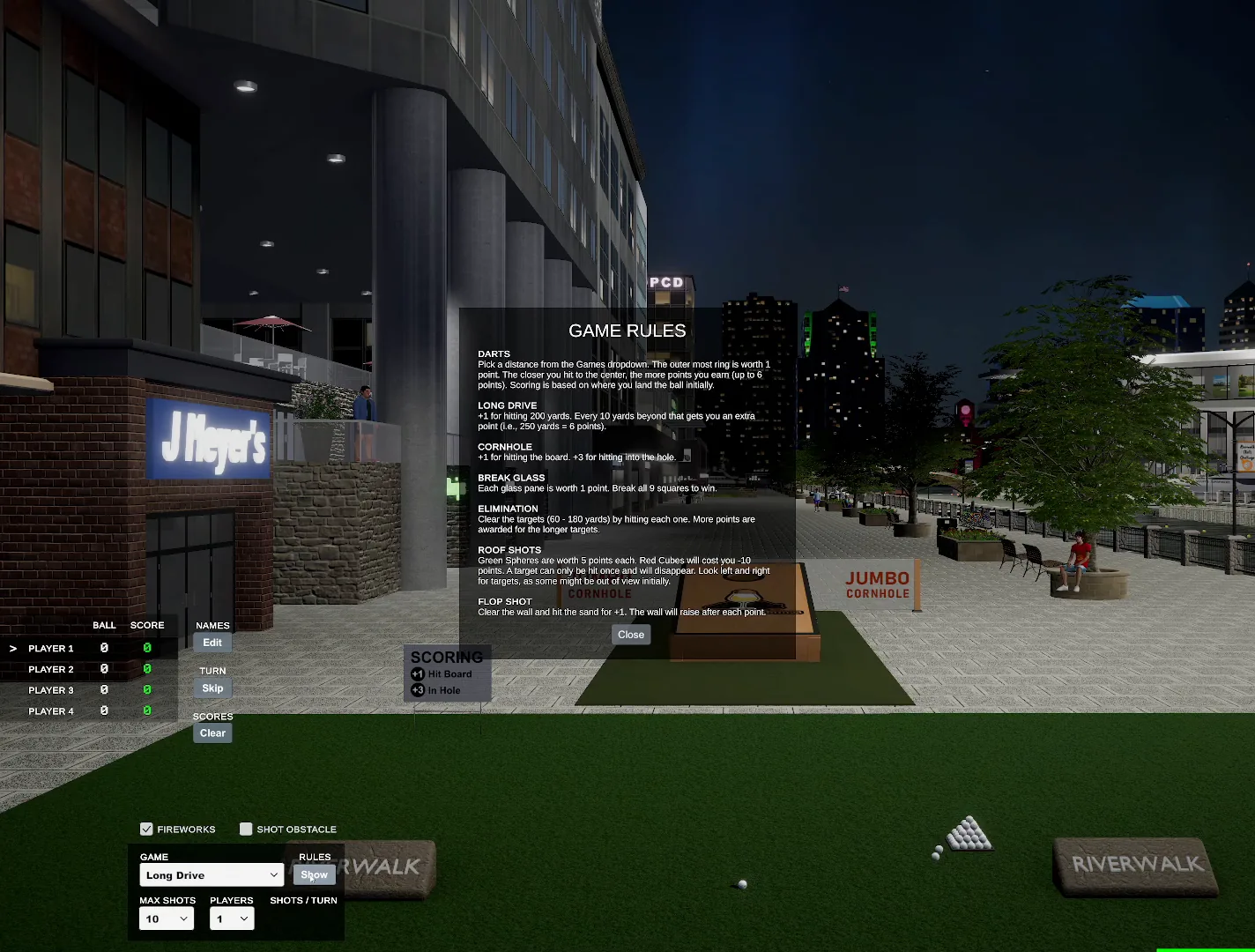
The scoring below is taken from the course's own GAME RULES panel, which you reach with RULES, then Show. One panel covers every game on the course.
Darts (Hole 1)
A floating island green out on the river, ringed and scored like a dartboard. The outer ring is worth 1 point, and the closer to the centre you finish the more you score, up to 6 points. Scoring is based on where the ball lands initially, not where it finishes, so a spinner that hops out still counts where it hit.
What nobody mentions is that Darts comes in twelve separate distances: 30, 50, 70, 90, 110, 120, 130, 140, 150, 160, 170, and 180 yards, each a separate entry in the dropdown. That is not a novelty target, that is a full gapping session with scoring attached. Work through all twelve and you have hit most of your bag at something that grades you.
This is the reason the dropdown runs to eighteen entries for seven games.
Cornhole (Hole 2)
A cornhole board. +1 for hitting the board, +3 for holing it.
The best short-game test in the set, because the 3-to-1 scoring means landing near is worth very little. You either commit to the number or you collect ones.
Break Glass (Hole 3)
A 3x3 wall of glass at 23 yards. Each pane is worth 1 point, and breaking all 9 wins.
The most immediately readable game here. There is nothing to explain, the score is visible from across the room, and nine panes is short enough that somebody who has never held a club can finish it. This is the one to hand to a guest.
Elimination (Hole 4)
One of the two that is hard to find anything written about.
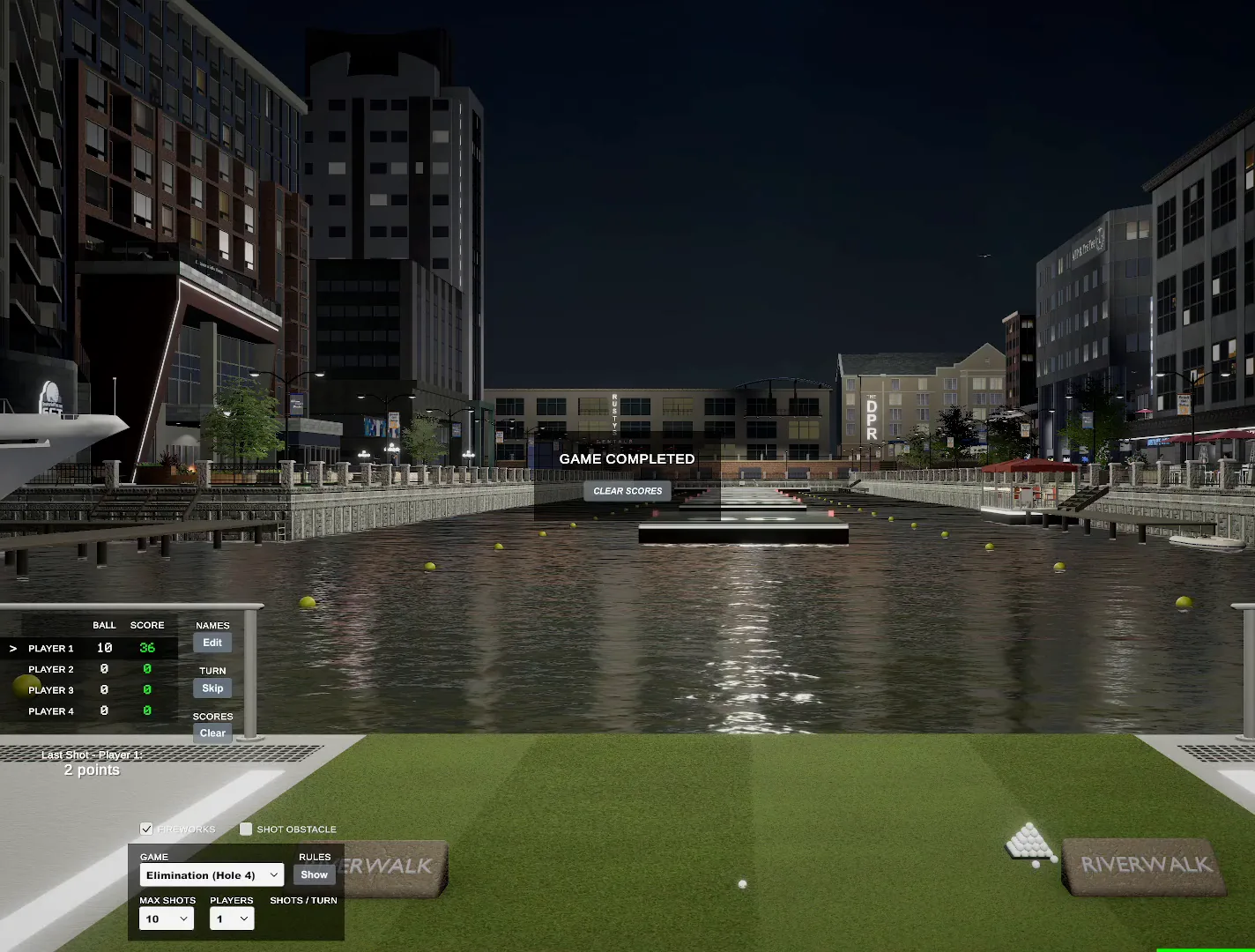
The rules: clear the targets, which sit from 60 to 180 yards, by hitting each one. Longer targets are worth more. So it is a distance ladder with a completion condition rather than an endless target game, and the scoring pushes you to go after the far ones early while you still have balls left.
Ten balls is the default and it is not generous. Getting through the set means very few wasted shots.
Roof Shots (Hole 5)
The other one that is hard to find written up, and the most interesting scoring design on the course.
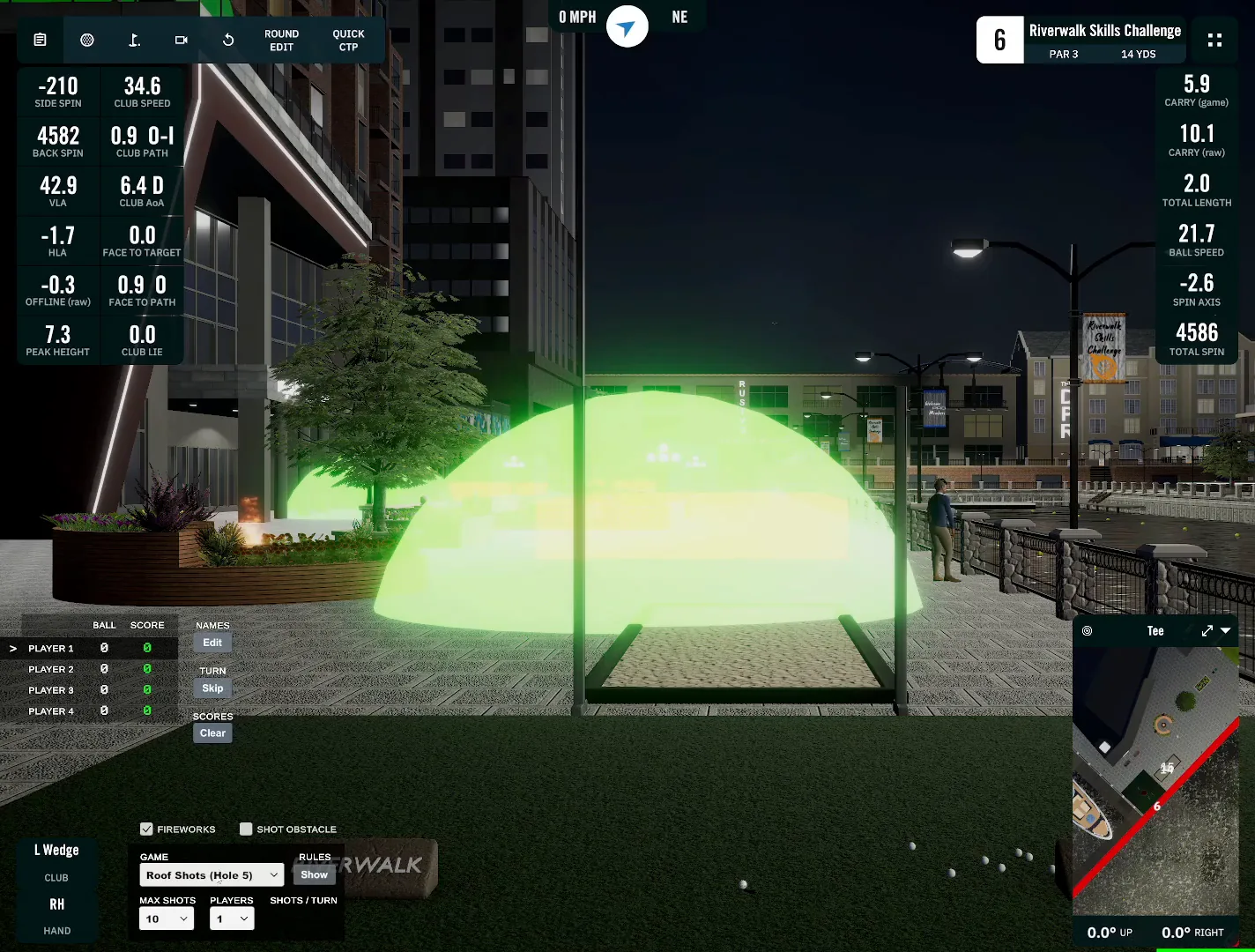
Green spheres are worth 5 points each. Red cubes cost you 10. A target can only be hit once and disappears afterwards. The rules panel adds a warning that matters: look left and right for targets, as some might be out of view initially.
That last part is what makes it. Every other game here puts the targets in front of you. This one hides some of them outside your starting field of view, and the red cubes mean a careless swing at something you have not properly looked at is a 10 point mistake. A 5 point reward against a 10 point penalty is an unusually harsh ratio, and it is the only game on this course where doing nothing beats guessing.
Top Flop (Hole 6)
The flop shot game, at 14 yards. The rules panel calls it Flop Shot while the dropdown calls it Top Flop, so it goes by both names.
Clear the wall and hit the sand for +1, and the wall raises after every point.
This is a coaching drill with scoring bolted on, and it is the most useful thing on the course. The flop is the shot most amateurs quietly avoid, and a wall that grows every time you succeed gives you a specific height where you fail instead of a vague sense that your short game is bad. Fourteen yards with a lob wedge over a rising wall is a genuinely hard, genuinely useful repetition.
Long Drive
+1 for reaching 200 yards, then an extra point for every 10 yards past it. 250 yards is 6 points.
Every simulator has one of these. This is a perfectly good version and the least interesting thing on the course.
Riverwalk is the practice one
Sorting the three GSPro mini-game collections by what they are actually for:
- Central Park is the party course. Beer pong, blackjack, a yacht you can hit people on. Free in base GSPro.
- Outpost 87 is the theme course, with one excellent practice tool buried in it.
- Riverwalk is the practice course. Twelve darts distances, a 3-to-1 cornhole board, and a rising flop wall are three drills you would pay a coach to set up.
If you have twenty minutes and want to get better rather than film something, this is the one to load. A reasonable order: Darts at three or four distances to find your gaps, then Cornhole until you are holing rather than landing, then Top Flop until the wall beats you.
Everything on this course is scored, which is the real point. A simulator range gives you a carry number and lets you decide whether it was good. These give you a total, and a total is harder to argue with.
The total is only as honest as the tracking
Worth saying before you take a bad Cornhole score personally: every game here is scored from the shot data your launch monitor produces, and short shots are the hardest thing for any of them to read confidently. Long Drive is measuring the shot type these units handle best. A 14-yard flop at the Top Flop wall is measuring the one they handle worst. If your short-game scores swing wildly between sessions while your driver scores do not, suspect the tracking before the swing. The launch monitor basics guide covers how radar and photometric units differ and what each accuracy tier actually buys you.
If you are still choosing that part of the build, the build planner works from the space and budget you have, and the room-fit check confirms the space itself.